

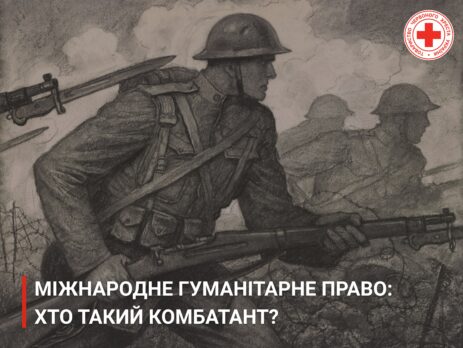
Combatants under International Humanitarian Law
During an international armed conflict, international humanitarian law (IHL) clearly distinguishes between civilians and combatants. In line with the principle of distinction, attacks against civilians are prohibited, whereas combatants are entitled to take part in hostilities and may constitute lawful military targets.
Combatants also benefit from the so-called “combatant’s privilege” — they are not held liable merely for participating in hostilities, provided that their actions do not violate IHL.
According to Article 43 of Additional Protocol I to the Geneva Conventions of 1949, combatants are persons who form part of the armed forces of a party to an international armed conflict (excluding medical and religious personnel):
“Members of the armed forces of a Party to a conflict … are combatants, that is to say, they have the right to participate directly in hostilities.”
This category also includes members of militias or volunteer corps forming part of such armed forces. At the same time, Article 4 of the Third Geneva Convention sets out specific conditions for members of other militias and volunteer corps, including those belonging to organised resistance movements. This status may also apply to inhabitants of non-occupied territory who take up arms to resist advancing forces.
If a combatant falls into the hands of the adverse party, they are entitled to prisoner-of-war status. As stated in Article 44 of Additional Protocol I:
“Any combatant who falls into the power of an adverse Party shall be a prisoner of war.”
At the same time, the “combatant’s privilege” does not extend to war crimes or other international crimes.
The Ukrainian Red Cross continues to raise awareness of international humanitarian law, explaining its rules and the importance of respecting them.